Start with the kind of break you need
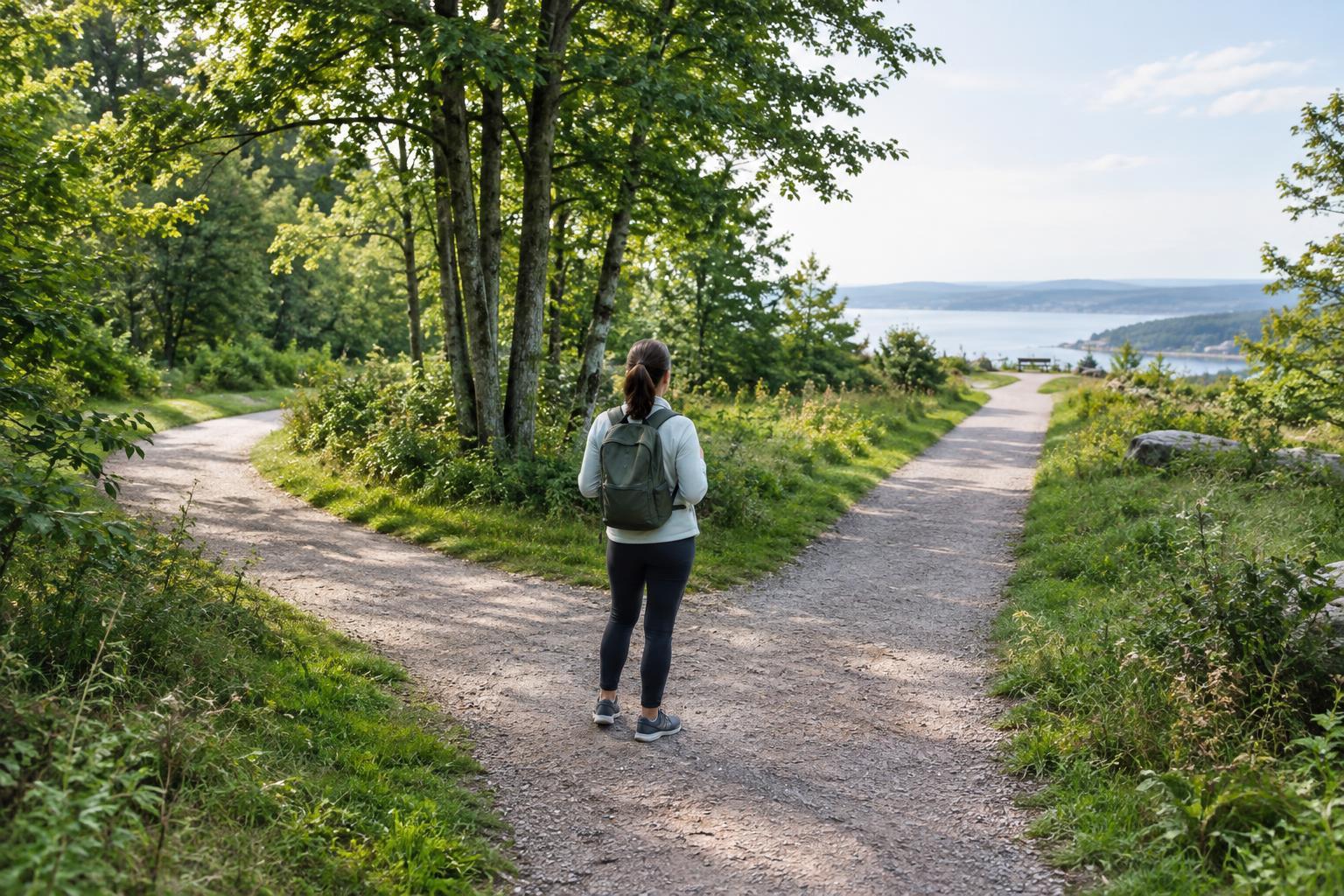
When you have only part of a morning or afternoon free, the best walk is not necessarily the longest or most scenic one. It is the route that lets you enjoy being outside without worrying about getting back on time. Two simple formats cover many short outings: a loop, which returns to your starting point by a different path, and an out-and-back, which follows the same path in both directions.
Neither format is always better. A loop can make a familiar area feel fresh because the view keeps changing. An out-and-back gives you a clear way to shorten the outing: turn around. Before choosing, decide what you want most from this particular walk. Are you looking for a change of scene, an unhurried conversation, a little quiet, or simply a reliable break between other plans? That answer is more useful than trying to pick the perfect route.
Choose a loop when variety matters
A loop works well when you want the outing to feel like a small journey. It may take you along a waterside path, through a neighborhood, and back by a different street. Because you do not retrace your steps, there is often something new to notice all the way home. A loop also gives the walk a natural ending: you arrive where you began without having to decide when to turn around.
The trade-off is commitment. Once you pass the point where doubling back would be quicker, completing the loop may be your simplest option. For a short outing, check the whole route before you leave rather than judging it by its first stretch. Look for crossings, steep sections, gaps in footpaths and places where the route might be hard to follow. If your schedule is tight, a modest loop with an obvious shortcut is usually more relaxing than an ambitious one.
Choose an out-and-back when flexibility matters
An out-and-back is useful when you are unsure how much time or energy you will have. You can walk for a set portion of your available time, then reverse course. The return path will be familiar, which can make navigation simpler in an unfamiliar park or along a straightforward trail. It is also easy to arrange a shared walk: everyone knows where the group will finish, even if you decide to turn around early.
Repeating the path does not have to feel repetitive. The view often changes when you face the other direction, and you may notice details you missed on the way out. You can give the walk a gentle purpose, such as reaching a bench, a bridge or a pleasant viewpoint. Just remember that the trip back still counts. Turn around while you have time to return comfortably, rather than treating the farthest point as the end of the outing.
Make the route fit your actual time
Start with the time you can spend away from home, not just the time you hope to spend walking. Allow for getting to the start, a possible pause and the trip home. If you are trying a route for the first time, leave some slack for slower stretches or a wrong turn. A short walk can feel restorative when it has room to breathe; it can feel like another appointment when every minute is accounted for.
For a loop, choose a route you can describe in a few clear stages: start, main path, turn and return. For an out-and-back, choose a turnaround point or set a reminder to check the time. Either way, note where you can leave the route early if needed. An outing close to home is not a lesser outing; it may be the one you will actually take on a busy weekend.
Keep the plan light and the return easy
A little preparation helps either format feel spontaneous. Check the route on a map, choose comfortable shoes for the surface and bring what you normally need for the expected weather and length. If you are walking with someone, agree on the pace and turnaround plan before setting off. For an unfamiliar route, it is worth checking whether paths and entrances suit everyone in your group rather than assuming they will.
If you still cannot decide, let the day choose. Pick a loop when you have comfortable time and want changing scenery. Pick an out-and-back when you want an easy option to stop sooner. The point is not to cover the most ground. It is to come home feeling that the walk fit the weekend you actually had.