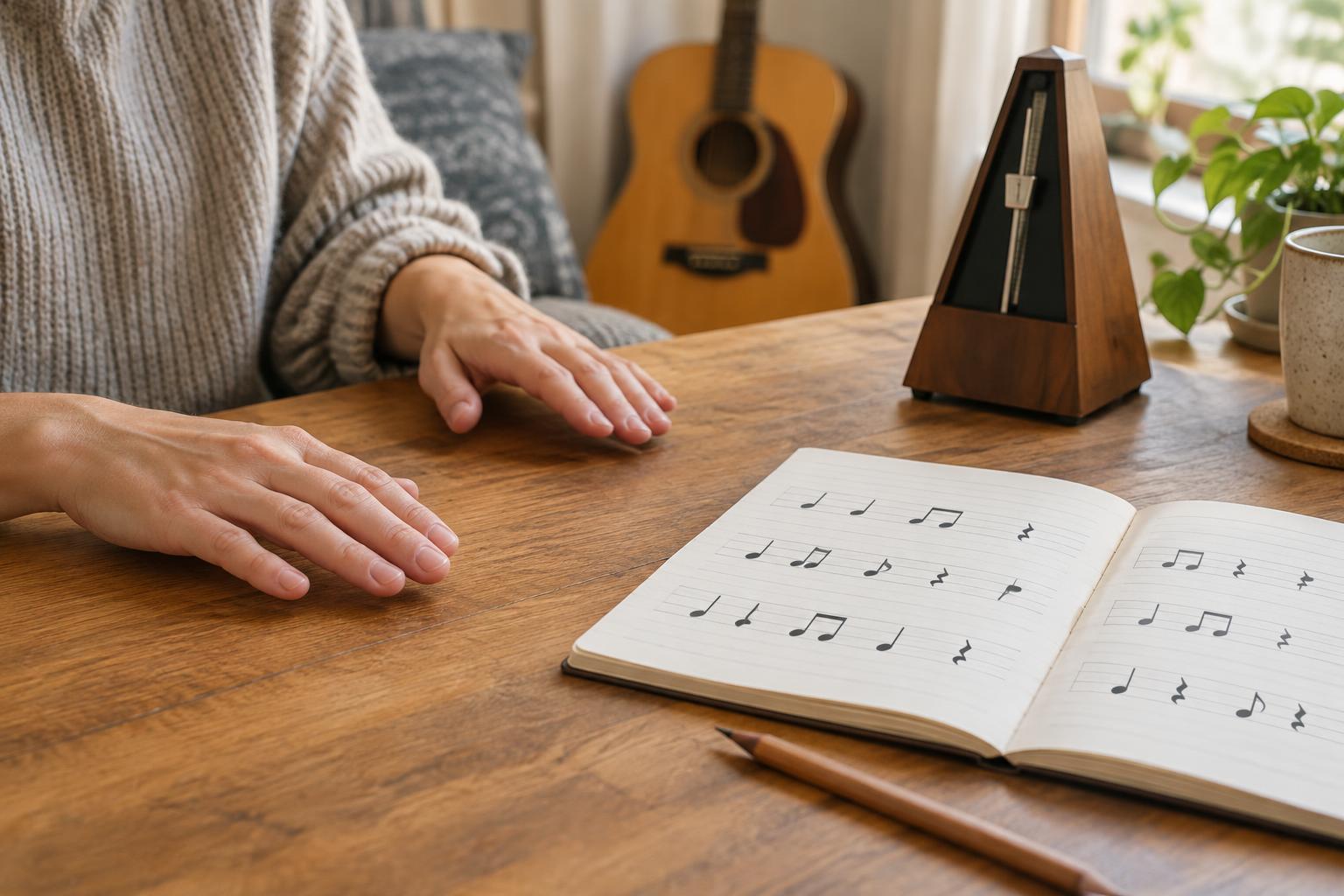
Start with the part you can hear and feel
A page of music can look crowded at first: lines, symbols, numbers and notes all ask for your attention. You do not have to learn everything at once. Rhythm is a useful place to begin because you can practice it without an instrument. If you can tap a steady beat and notice when a sound starts or stops, you already have something to build on.
Set aside ten or fifteen minutes for your first session. Choose a quiet spot, put a pencil and a sheet of paper nearby, and tap your hand gently on a table or your knee. Keep the taps evenly spaced. That repeating pulse is the beat. Rhythm describes how sounds and silences fit around it. You can make a rhythm by clapping on some beats and staying silent on others, even before you know the names of the symbols.
Use a four-beat measure as your starting point
Look for a time signature near the beginning of a piece of music. For this first exercise, use music marked 4/4. Its top number tells you to count four beats in each measure; in this time signature, a quarter note gets one beat. A measure is the space between two vertical bar lines. Count “one, two, three, four,” then begin again at one for the next measure.
Now meet three note values. In 4/4, a quarter note lasts one beat, a half note lasts two, and a whole note lasts four. Tap four times while saying “one, two, three, four.” Next, clap on one and three, letting each clap carry through two beats. Finally, clap only on one and let the sound—or the space after it—last until the next measure. The goal is not to hold a clap perfectly. It is to feel when the next sound belongs.
Write a few four-beat combinations on paper using words before worrying about notation: “one beat, one beat, two beats” or “two beats, one beat, one beat.” Check that each combination adds up to four. Then clap it while your foot or other hand keeps the beat. Separating the steady pulse from the claps helps you hear what the written durations mean.
Add smaller sounds and deliberate silences
When four quarter notes feel comfortable, try dividing each beat in two. Say “one-and, two-and, three-and, four-and,” keeping the numbers aligned with your steady taps. Two eighth notes fit into one beat in 4/4; you can clap on both “one” and “and” while tapping once for that beat. Start with just one pair of eighth notes in a measure, followed by three quarter notes. If the taps speed up when you clap the smaller notes, slow everything down.
Silence has a place on the page, too. A rest tells you not to play for a specified duration, but the beat continues. For a simple exercise, count four beats aloud and clap on one, stay silent on two, then clap on three and four. The quiet beat is not a pause in your counting. Treat it as an action: keep tapping, leave out the clap, and come back in on time.
Make each practice session small and repeatable
Try a short routine whenever you have a spare moment. Spend two minutes tapping a steady four-count. Spend three minutes clapping a measure made from quarter and half notes. Then spend three minutes adding either eighth notes or a rest. For the last couple of minutes, repeat one measure until you can clap it comfortably three times in a row. You can practice with a metronome if you like, but counting aloud and tapping steadily are enough to begin.
If you have an instrument, play a single comfortable note for every clap. Ignore pitch changes for now; this session is about timing. If you do not have an instrument, your hands work just as well. Keep your examples short enough that you can remember what comes next. Accuracy at a relaxed pace is more useful than racing through a full page.
Know when to move on
After a few sessions, find a short beginner exercise in 4/4 and inspect it before making a sound. Mark the four beats of each measure with your pencil. Point to each note or rest while counting aloud, then clap the rhythm. If you lose your place, return to the start of that measure and go more slowly. Losing the beat is a cue to simplify, not a reason to start the entire piece over.
Once you can keep a steady count while clapping several measures, you are ready to add another layer, such as reading pitch names on the staff. Continue to practice rhythm on its own occasionally. A familiar beat gives you a dependable place to return to when the rest of the page starts to feel busy.


