Start with the outing you actually want
An easy nature trail should feel like a pleasant break, not a test of endurance. Before looking at routes, decide how much of your weekend you want to give the outing. Include travel, parking, the walk itself and time to pause. If your free window is short, a nearby loop with a clear start and finish may be more satisfying than a scenic trail that takes a long drive to reach.
Think about who is coming and what would make the walk comfortable for everyone. A companion who prefers a steady stroll, a child who likes to stop and look around, or anyone new to uneven ground may enjoy a shorter route with flexible turnaround points. Choose a pace that leaves room to notice trees, birds or changing light rather than one that depends on reaching a destination.
Read the trail description beyond the distance
Distance is useful, but it does not tell the whole story. Check whether the route is a loop or an out-and-back walk, how much it climbs, and what the surface is like. A short path with steep steps or loose stones may feel harder than a longer, mostly level path. Words such as “easy” can mean different things to different people, so look for specific details about slopes, obstacles and footing.
Find out where the trail begins and whether the entrance, parking area and route are clearly identified. If the location provides an official map or visitor information, check it before leaving for any access rules, seasonal restrictions or facilities you may need. For a first outing, a well-marked route in a familiar park or nature area is often simpler than a network of intersecting paths. Keep an alternative nearby in mind in case the first choice is crowded, closed or less comfortable than expected.
Pack for comfort, not for an expedition
Wear shoes that are comfortable for the expected surface and clothing you can adjust if the temperature changes. Bring water, a small snack, sun protection or a light layer as appropriate for the conditions. A charged phone is helpful, but do not make it your only plan for finding your way. Save or carry a map of the route, especially where reception may be uncertain.
Before setting out, check the forecast and give yourself enough daylight to return without rushing. Tell someone where you plan to walk if you are going alone. These small steps do not need to turn a casual outing into a complicated project; they simply make it easier to enjoy the walk. If a trail calls for equipment or preparation you do not have, choose a different trail for this weekend.
Follow the route one decision point at a time
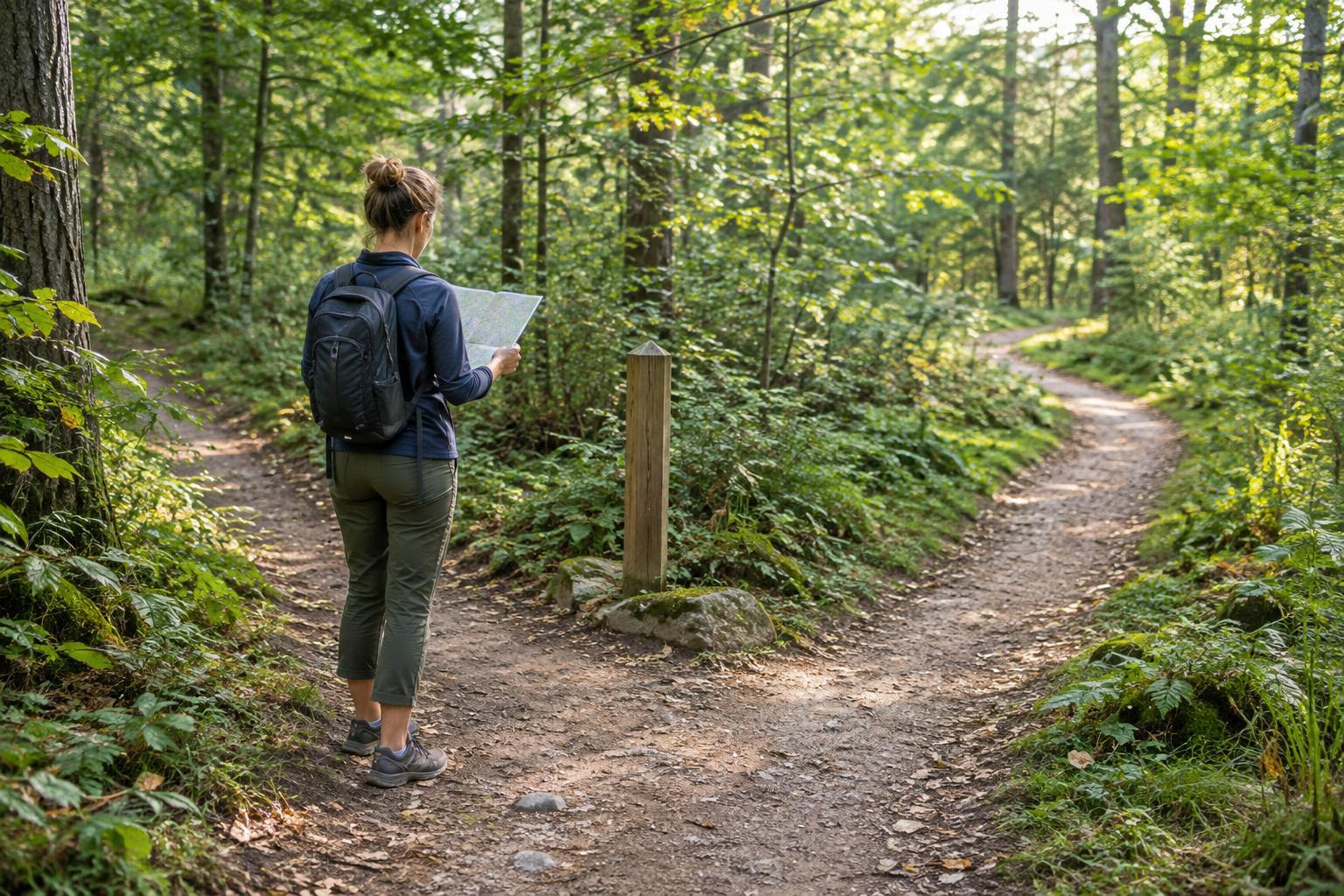
At the trailhead, take a moment to compare the posted map with the route you chose. Note the trail name, marker color or symbol, and any junctions where you will need to turn. On an out-and-back walk, notice landmarks as you go so they will be recognizable from the opposite direction. At a junction, stop and check the marker or map before continuing rather than assuming the widest path is the right one.
Set a simple turnaround time before you start, leaving enough time for the return at an unhurried pace. If markers disappear, the path becomes unclear, or the terrain feels beyond what you expected, pause. Retrace your steps to the last place where you were certain of the route instead of pressing ahead to see whether it clears up. Turning back is a sound choice, not a failed outing.
Leave room for the good part
A beginner-friendly walk does not need a grand viewpoint to be worthwhile. Give yourself permission to stop at an interesting leaf, listen for different sounds, or sit for a few minutes where stopping is permitted. Stay on the designated trail, give other walkers space, and leave plants, rocks and wildlife undisturbed. Carry out anything you bring in.
Afterward, make a quick mental note of what worked: the length, surface, travel time and what you were glad to have packed. That gives you a better guide for choosing the next route than a difficulty label alone. Over time, a few easy trails can become a dependable weekend option—one you can adapt to your energy, the weather and the time you have.


